
- News
- Sports News
- Tennis News
- Time-clock is a must, says Cilic
Trending
This story is from January 2, 2018
Time-clock is a must, says Cilic
Marin Cilic doesn’t want the basic structure of the game to be tinkered with, but believes ‘time-clock’ is a must to make the rules fair and consistent.
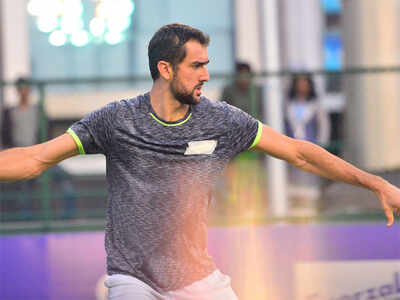
PUNE: Marin Cilic doesn’t want the basic structure of the game to be tinkered with, but believes ‘time-clock’ is a must to make the rules fair and consistent.
Tennis authorities have been experimenting with a few changes in the game in their attempt to keep the game relevant to the younger generation.
In the Next Gen Finals featuring the top under-21 players, the ATP World Tour trialled a shorter format — best of five four-game sets with tiebreak at 3-3 all — shorter warm-up, shot clock, no-let rule, player coaching and single medical timeout.
“I am still a traditional guy. I like the rules the way they are. Some small changes are necessary (in keeping) with the technology, they are always welcome,” the 29-year-old Croat told TOI during an exclusive chat at the $560,000 Tata Open Maharashtra on Monday.
So with the coaching, the traditional, stays with the way it is.”
The World No. 6 said he felt ‘time-clock’, used to impose 25-second rule between points, was necessary because the umpires have been inconsistent in imposing the code.
“It is where I think the referees are not very consistent. Sometimes, (they are) a little bit harder in their decisions, and sometimes leaner (lenient). And some guys are getting (away) more often than the others,” the 2014 US Open champion said. “For me, the time-clock should be there, but still a referee should be there to see if the crowd is interfering, or if there is a big noise, when he can be a little lenient.”
Rafael Nadal had said earlier that during long-drawn five-set matches, chair umpires should take that into consideration while applying the rule. But Cilic didn’t agree. “No, it doesn’t (warrant leniency). I know that I am also sometimes going over the clock. But if we have a rule and that is consistent, we will all adapt to that rule. For me, if the match goes five-sets, if the points are long, it is upto the players to fight and see who is better. That is part of the game,” he said.
Multiple bodies — ATP, WTA, ITF and Grand Slams Committee — running the sport has been a topic of debate, but Cilic felt the issue was the poor contribution of the four majors to the overall financial health of tennis. “We all need to work for the game, work to be fair. In some cases, I think the Grand Slams are taking the cream … They are on the top and organising those (major) events, but they have to be fair in making contributions to the Tour,” he said.
However, he didn’t agree increased prize share for the doubles. “They are always going to say they require more prize money. I am not sure (how much they get), at the moment they are getting 20 or 25 per cent. I think overall doubles players are earning good money and making good living. ”
Looking ahead, Cilic took heart from his Wimbledon final performance against Roger Federer this year when the latter annexed his 19th Slam with a 6-3, 6-1, 6-4 win over the Croat.
“For me, when I was confronting him, he was a big challenge. But he was also a big drive for me to test how I am going to perform.
Tennis authorities have been experimenting with a few changes in the game in their attempt to keep the game relevant to the younger generation.
In the Next Gen Finals featuring the top under-21 players, the ATP World Tour trialled a shorter format — best of five four-game sets with tiebreak at 3-3 all — shorter warm-up, shot clock, no-let rule, player coaching and single medical timeout.
“I am still a traditional guy. I like the rules the way they are. Some small changes are necessary (in keeping) with the technology, they are always welcome,” the 29-year-old Croat told TOI during an exclusive chat at the $560,000 Tata Open Maharashtra on Monday.
“For me the changes could be the use of hawk-eye a little more often; time-clock, which we are going to use at the Australian Open. Just small things like that, nothing major that would interfere with the game, interfere with the change of the format of the set.
So with the coaching, the traditional, stays with the way it is.”
The World No. 6 said he felt ‘time-clock’, used to impose 25-second rule between points, was necessary because the umpires have been inconsistent in imposing the code.
“It is where I think the referees are not very consistent. Sometimes, (they are) a little bit harder in their decisions, and sometimes leaner (lenient). And some guys are getting (away) more often than the others,” the 2014 US Open champion said. “For me, the time-clock should be there, but still a referee should be there to see if the crowd is interfering, or if there is a big noise, when he can be a little lenient.”
Rafael Nadal had said earlier that during long-drawn five-set matches, chair umpires should take that into consideration while applying the rule. But Cilic didn’t agree. “No, it doesn’t (warrant leniency). I know that I am also sometimes going over the clock. But if we have a rule and that is consistent, we will all adapt to that rule. For me, if the match goes five-sets, if the points are long, it is upto the players to fight and see who is better. That is part of the game,” he said.
Multiple bodies — ATP, WTA, ITF and Grand Slams Committee — running the sport has been a topic of debate, but Cilic felt the issue was the poor contribution of the four majors to the overall financial health of tennis. “We all need to work for the game, work to be fair. In some cases, I think the Grand Slams are taking the cream … They are on the top and organising those (major) events, but they have to be fair in making contributions to the Tour,” he said.
However, he didn’t agree increased prize share for the doubles. “They are always going to say they require more prize money. I am not sure (how much they get), at the moment they are getting 20 or 25 per cent. I think overall doubles players are earning good money and making good living. ”
Looking ahead, Cilic took heart from his Wimbledon final performance against Roger Federer this year when the latter annexed his 19th Slam with a 6-3, 6-1, 6-4 win over the Croat.
“For me, when I was confronting him, he was a big challenge. But he was also a big drive for me to test how I am going to perform.
End of Article
FOLLOW US ON SOCIAL MEDIA





Top Sports News
TOP TRENDING
Trending Stories
In Sports
Entire Website
- Shreyas Iyer comes out to bat wearing sunglasses, falls for a duck in Duleep Trophy
- Shannon Sharpe Denies Involvement in Controversial Video Amid Cyber Attack Claims
- Tyreek Hill Kids: How Many Children Does He Have?
- WWE Superstar Cody Rhodes and his Wife Brandi Rhodes Share Special Messages on Their 11th Anniversary
- NFL icon Adrian Peterson's financial struggles, Houston Court orders $12.5 Million repayment
- Matthew Stafford’s wife Kelly reveals how Rams QB identified Jordan Love’s injury instantly
- 5 WWE Superstars Who Can Make John Cena Tap Out
- Is Dominik Mysterio Richer Than His Dad Rey Mysterio? Let's compare the wealth of Dirty Dom with the Hall of Famer
- Jalen Hurts Announced That His Foundation Will Donate $5000 Per Touchdown To Provide AC For Philadelphia Schools
- Afghanistan vs New Zealand breaks 91-year record with Test cancellation; full list of matches abandoned without a ball bowled
- Satellite-based toll system to have factory-fitted unit, phased launch
- Encounter breaks out between security forces and terrorists in J&K's Baramulla
- Will Germany’s suspension of Schengen entry end the Europe dream?
- Tamil Nadu hotelier’s apology to FM over GST remark triggers row
- 'Water reached tomb of Shahjahan': Leaking from Taj Mahal's dome
- Fake police make woman lawyer strip on video call in Mumbai
- How Swift is uniting the sisterhood to stop Trump's second coming
- Infosys founder Narayana Murthy: My wife's logic was ...
- Delhi gets its CM back: How Kejriwal's return will impact Haryana polls
- Ind vs Pak: Why is India hot favourite for the ACT hockey match

Popular Categories
Hot on the Web
Top Trends
Moin KhanShreyas IyerWhere to Watch IND vs PAK Hockey MatchShannon Sharpes Net WorthVande MetroAadhaar Card UpdateTech LayoffsShannon SharpeUPSC Mains Admit CardKristina JoksimovicWay Chatgpt can be your Study PartnerAir Taxi IndiaAyushman Bharat SchemeKolkata Doctor Rape CaseDonald TrumpDiljit DosanjhLive Cricket Score
Trending Topics
Alia BhattMalaika Arora Father DeathArbaaz KhanNatasa StankovicMr Bachchan OTT ReleaseNational Parks In IndiaSelena GomezGOAT CollectionVikas Sethi DeathMalayalam ProducersIndia's Best Dancer 4Simi GarewalDilli BabuIndian National ParksLaung BenefitsVikas SethiApple iPhone 16SpaceXAadhar Card Update By Sept 14Wordle Answer
Living and entertainment
Latest News
Regina Cassandra calls herself a 'serial dater,' had many relationships :'But I’m taking a break now'Kaun Banega Crorepati 16: Can you guess the answer for this Rs 3,20,000 question on Navy, which contestant Naman Jain incorrectly answered?Exclusive - Has Palak Sindhwani aka Sonu from Taarak Mehta Ka Ooltah Chashmah breached her contract; Neela Film Productions to issue a legal notice to the actress?Mexico's president asks Sinaloa cartel to act 'responsibly' as violence escalates in the northKitchen Tips: How to elevate home cooking to Michelin levelFord drives into India for 3rd timePIL: Publicise laws, penalties to curb crimes against womenGrowth potential 7.5% or more: RBI governorHindus take to Bangladesh streets to stop attacks and demand justiceE-commerce speeds up to catch up with Quick commerce'Will take digital public infrastructure stack to 50 nations'Justin Timberlake faces DWI charges: Court-ordered apology, fine and community serviceTragic road accident on Mogili ghat road claims seven lives in Chittoor districtSebi gives clean chit to NSE, ex-executives in co-location caseRusty or Ready? Falcons' Cousins Falls Flat in $180M NFL DebutRaveena Tandon apologizes to fans for not photo snub in London: "It was not my intention to offend"Edible oil import duty hiked by 20%Preschools turn nursing homes, retirement age raised: China's demographic crisis explodes
Copyright © 2024 Bennett, Coleman & Co. Ltd. All rights reserved. For reprint rights: Times Syndication Service